

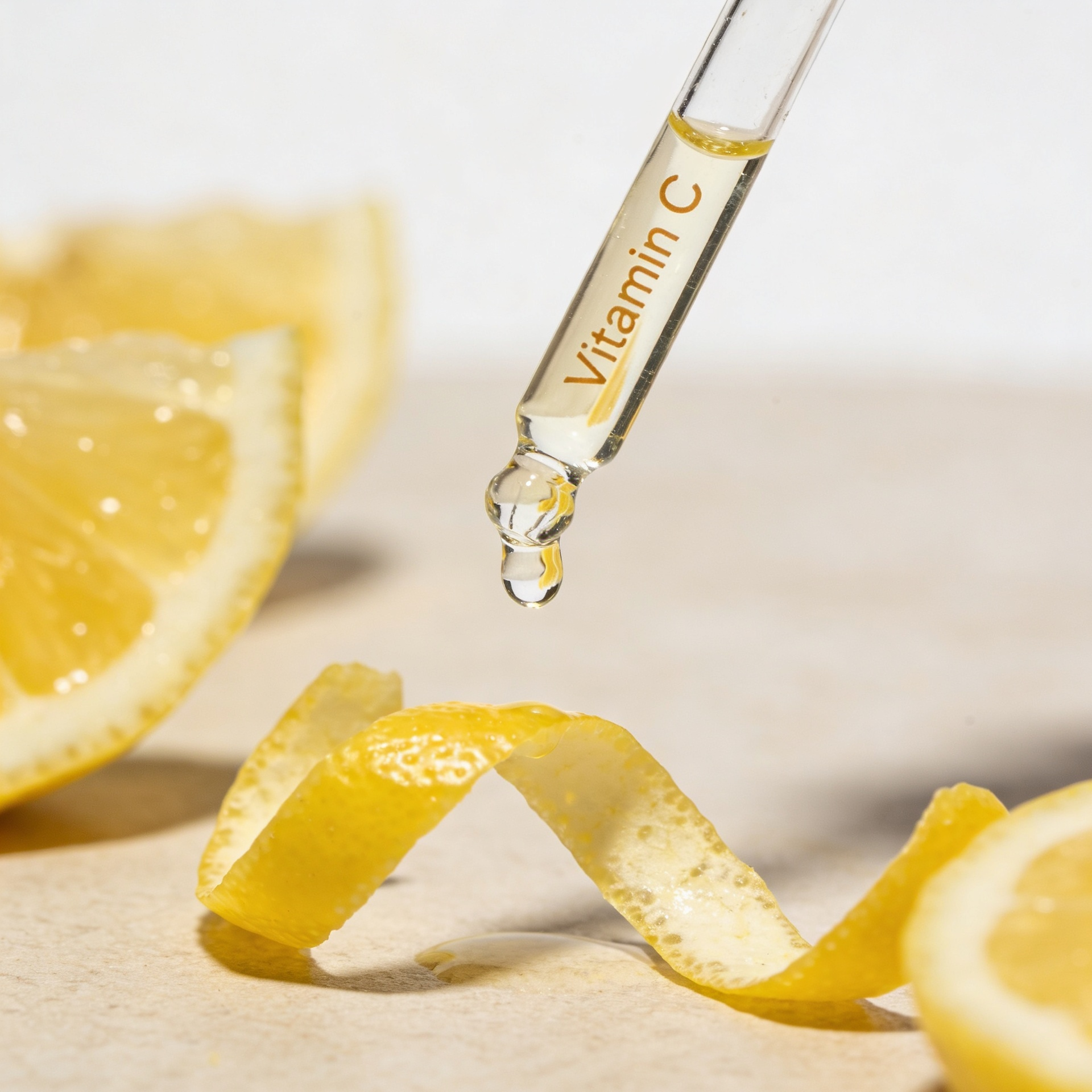
For a Vitamin C serum to be truly effective, it must contain a chemically stable form of the vitamin, such as Sodium Ascorbyl Phosphate (SAP). Unlike pure ascorbic acid, which rapidly oxidizes and irritates the skin, SAP is an intelligently formulated molecule. It penetrates safely and converts into active vitamin C directly within the cells. Clinical data shows that SAP works on three levels simultaneously: it stimulates collagen production up to 8 times, reduces melanin production by 57% to lighten spots, and acts as a powerful antimicrobial agent for acne treatment without side effects.
In the world of modern skincare, Vitamin C is considered the holy grail of antioxidants. Promises of a radiant face, even skin tone, and erased fine lines lead millions of women to incorporate this vitamin into their daily ritual. But the reality in the bathroom is often different.
Many users share their frustration: they buy an expensive serum, but after a few weeks, the liquid changes color to dark orange or brown, the smell worsens, and applying it causes redness, stinging, or even breakouts.
As experts dedicated to skin health, we believe that effective cosmetics should not require compromising on comfort. The problem is not with your skin, but with a key scientific detail that mass marketing often overlooks: the stability of the molecule.
To build an effective routine for radiant skin, we must first understand the paradox of Vitamin C and why the form in which it is delivered to cells is the true secret to success.
The Paradox of Vitamin C: Why the pure form can harm?
Quick fact: In its natural state (as L-ascorbic acid / pure ascorbic acid), Vitamin C is extremely unstable. Upon contact with light, air, or water, its molecule immediately begins to decompose.
Imagine a cut apple left on the kitchen counter – after just a few minutes, it darkens due to oxidation processes. Exactly the same thing happens with unstable Vitamin C serums. When the molecule oxidizes, it doesn't just lose its beneficial properties. It becomes a pro-oxidant – a substance that can actually generate free radicals and accelerate aging, instead of preventing it.
The second major challenge is acidity. For pure ascorbic acid to penetrate the skin, the product must be formulated with a very low (aggressive) pH. This is the main reason for the burning sensation, disruption of the skin barrier, and triggering of sensitivity.
The logical solution is for dermatological science to create a form that is resistant to external factors and at the same time gentle on tissues. This is where Sodium Ascorbyl Phosphate (SAP) comes into play.
Sodium Ascorbyl Phosphate (SAP): The Intelligent Evolution of Vitamin C
In our formulas, we use Sodium Ascorbyl Phosphate – a water-soluble, extremely stable derivative of Vitamin C. Its biological essence is ingenious: instead of being aggressive on the skin's surface, it penetrates deeply, and only when it reaches living cells, do the body's enzymes convert it into active Vitamin C.
This mechanism guarantees 100% efficacy without any irritation whatsoever. According to clinical data, SAP possesses a powerful triple spectrum of action:
1. The Architect of Youth (Collagen Stimulator)
Skin aging is directly related to the degradation of collagen fibers.
- Proven action: The prolonged effect of this form of Vitamin C on tissue-connecting cells sends a biological signal that stimulates new collagen synthesis by up to 8 times.
- Your benefit: The skin regains its density and firmness, and the formation of fine lines and wrinkles is prevented at a structural level.
2. The Lightening Agent (Pigmentation Control)
Sunlight, age, and hormonal changes often lead to melanin overproduction, which manifests as dark spots (hyperpigmentation).
- Proven action: Clinical studies show that SAP actively inhibits the enzymes responsible for skin discoloration, reducing melanogenesis (melanin production) in human melanocytes by an impressive 57%.
- Your benefit: Dark spots and acne scars lighten, and the face acquires an even, porcelain-like, and healthy glow.
3. The Invisible Shield Against Acne (Antimicrobial Activity)
It is widely believed that Vitamin C is not suitable for problematic and acne-prone skin. While this is true for pure ascorbic acid, for SAP, science proves the exact opposite.
- Proven action: In vitro and in vivo tests prove that a concentration of just 1% SAP has a strong antimicrobial effect. When using 5% content for 12 weeks, the formula demonstrates visible acne healing.
- Your benefit: This ingredient offers an effective, non-antibiotic treatment for pimples and inflammation, without drying or causing flaking and side effects.
Limitations: When can Vitamin C harm your skin?
As experts, we believe in uncompromising transparency. There are critical mistakes in choosing Vitamin C that the industry often keeps silent about:
- Using an oxidized product: If your pure Vitamin C serum has changed color to brown or smells metallic/rusty, it has already become a pro-oxidant. Applying it to your face literally causes oxidative stress and cellular damage.
- The myth of high percentages: Many consumers look for products with 15% or 20% pure ascorbic acid, believing that "more is better." In reality, such high concentrations of an unstable acid can drastically disrupt the skin barrier, triggering contact dermatitis, redness, and increased sun sensitivity.
- Lack of photoprotection: Although stable Vitamin C (like SAP) is perfect for daily use and even enhances the skin's protection against free radicals, it should never replace your sunscreen (SPF).
Our philosophy: Care based on uncompromising science
When developing our formulas, we refuse to compromise on the long-term health of your skin. Using cheap, unstable forms of Vitamin C that provide a marketing label but risk epidermal health contradicts our standards.
The choice of Sodium Ascorbyl Phosphate (SAP) is our promise of intelligent care. We incorporate this high-tech molecule because we believe your skin deserves an ingredient that works in full synergy with its biology – transforming into an active antioxidant only when it is completely safe inside the cell.
Your skin is a complex ecosystem. When you choose a formula created with respect for its anatomy, you invest not just in temporary brightening, but in real structural protection, strength, and genuine, unadulterated beauty.


